Few people realize how severe the current drought in California is. Droughts are gauged by the U.S. Drought Monitor on a scale of D0 to D4:
D0 - abnormally dry
D1 - moderate drought
D2 - severe drought
D3 - extreme drought
D4 - exceptional drought
The great California drought began in January of 2012; by the end of that month, most of 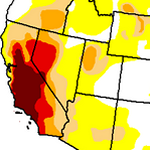 the state was either abnormally dry (D0) or in a moderate drought (D1). By summer 2012, large portions of the state were afflicted with severe drought (D2). By the following summer, July 2013, almost the entire state was engulfed in severe drought (D2). And toward the end of 2013, large areas advanced into extreme drought (D3). By the end of January, 2014, extreme drought (D3) encompassed most of the state, with some large areas in exceptional drought (D4).
As the year 2014 continued into late summer, areas in California under exceptional drought (D4) expanded to include most of the state. Then, throughout the rest of 2014, most of the state was under either exceptional drought (D4) or extreme drought (D3). The situation remained the same throughout all of 2015, even to the present day (March, 2016). If the drought in CA were to become severe (D2), that would be an improvement.
This drought has lasted over 4 years, from January 2012 to March 2016. What would it take to end the drought? I’m sorry, but a few days or weeks of steady rain will not suffice. The underground aquifers in CA have nearly dried out from lack of rain. Agriculture in the state has pumped water from these aquifers at a rate beyond what nature could replenish even with higher than normal rainfall for months on end. CA would need much higher rainfall than normal for several years to end the drought and replenish the underground aquifers. Such a severe change in the weather patterns for the state is highly unlikely.
My take: agriculture in California is terminally ill. Current rainfall levels cannot support agriculture without vast amounts of water from irrigation. But overuse of irrigation from wells has pumped underground aquifers dry. Even if the rainfall level returns to normal, the aquifers won’t be replenished by mere normal (pre-drought) levels of rainfall. Those are the only two sources of water for agriculture in CA: rainfall and irrigation from wells. Desalinated water is far too expensive to use in agriculture. And irrigation from rivers, lakes, or reservoirs is precluded by the drought.
If we consider average annual precipitation in the U.S. over the long term, the eastern half of the nation has always had substantially more rainfall than the western half.
The most practical solution to the drought in California — which, by the way, is also afflicting other western states to a lesser extent — is to increase the amount of land used for agriculture in the eastern half of the nation, and decrease the land used for agriculture in California. Yes, I’m saying that agriculture in CA cannot survive the drought. And since CA provides the U.S. with substantial amounts of food, the loss of that fertile farming land needs to be replaced by converting more land in the east for use in farming.
California uses about 8 million acres of land for crops, which is about 2.4% of the total U.S. cropland used for crops. The Midwestern States have the most land dedicated to use in agriculture. But the eastern states have the most rainfall. Also, the Midwestern States use so much land for farming that it would be very difficult to add even more cropland. So the problem is that we need to add more land for agriculture where rainfall is highest. But land is valuable for homes, businesses, and expansion of cities and towns. We need to add cropland, but the current trend is toward a decrease in land used for farming in the U.S.
The most likely result of the impending agricultural disaster in CA: a food crisis in the U.S. in which we cannot feed our own population. We will become dependent on food imports from other nations. Food prices will skyrocket, and availability of many foods will become spotty. When, not if, agriculture in CA collapses under the weight of the drought, we will lose 8 million acres of cropland. And replacement of that land is unlikely, given the various economic pressures and competing demands for land use. The short-term outlook is not good, people, not good at all.
- Thoreau