
Here’s a disaster scenario that Preppers don’t often consider: the world is running low on sources of fresh water.
Twenty-one of the world’s 37 largest aquifers - in locations from India and China to the United States and France - have passed their sustainability tipping points, meaning more water is being removed than replaced from these vital underground reservoirs.
Thirteen of 37 aquifers fell at rates that put them into the most troubled category.“The situation is quite critical,” said Jay Famiglietti, senior water scientist at Nasa’s Jet Propulsion Laboratory and the studies’ principal investigator. [Source]
California is not the only location in the U.S. that is in trouble. There are large aquifers under much of the Midwest. But farmers have been tapping these water sources with an ever-increasing number of wells to irrigate crops. At the current rate, these wells will go dry, and no amount of rain in the short term will be able to replenish them. “These groundwater reserves take thousands of years to accumulate and only slowly recharge with water from snowmelt and rains.”
What is the solution to this problem? There isn’t one. When you need to grow crops to feed over 7 billion persons, rainwater alone does not suffice. Coastal regions can make fresh water from sea water by desalination. But that water is expensive to make, and expensive to pipe to farmlands. In the Midwest, the breadbasket of the U.S., they are too far from any ocean for desalinization. And once the wells go dry, agriculture will be devastated. This could happen rather suddenly.
Without any source of water except rainfall, agriculture in the U.S. would be drastically different.
Dryland farming can be done with only 10 inches (250 mm) of rainfall per year, if that rain is concentrated mainly in one rainy season of a few months. Otherwise, you might need 20 inches of rain for dryland farming. Even then, relatively few crops can be grown with so little water. And corn is not one of those crops.
Maize (corn) is the number one crop grown in the U.S. and in the world. More corn is grown than wheat, or rice, or any other staple food. Some of that corn makes ethanol for biofuel. Much of the rest is used for livestock feed. Without a huge yearly supply of corn, livestock feed will not exist. Switching to some other grain for livestock feed would take away supplies of that grain for human use. This could seriously disrupt the supply of meat and poultry.
Take a look at the following map of U.S. average yearly precipitation:
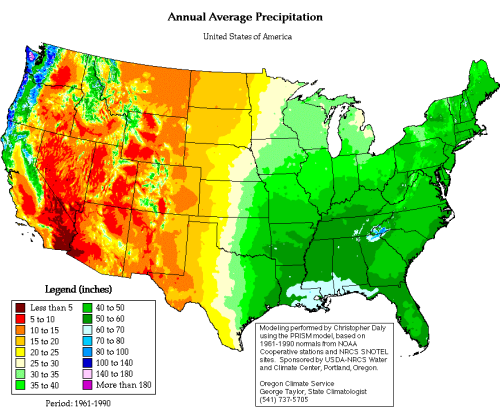
The red and orange shades probably have too little rainfall for commercial agriculture. Yes, you can grow crops with 10 to 20 inches of rain per year. But not commercially. You would only be able to grow one crop per year. Yet you would be competing in the marketplace with farmers who grow three crops per year. Your one crop per year will have much lower yields than a farmer with higher rainfall. These factors combine to make commercial agriculture unlikely to succeed financially over much of the western U.S.
The current drought in California actually extends well into Oregon and Washington state. So an end to irrigation from underground aquifers plus the drought will cause a collapse of agriculture over about half of the U.S. Then the rest of the nation would have to adjust expected yields, types of crops grown, and expected net income. Irrigation increases yields. Once irrigation is no longer available, yields fall substantially.
Some disaster scenarios are unpredictable, such as a major earthquake or a massive volcanic eruption. But the approaching agricultural disaster is inevitable. We are in fact taking more water from the ground than can be replaced even by higher than normal precipitation. The drought in California has gone on for so long that a change in the weather pattern will not be sufficient. There is no solution. Get ready for much higher prices at the grocery store, sporadic availability of many foods, and a sharp increase in the prices of meat, poultry, and dairy products.
- Thoreau

Maybe if we stopped building swimming pools and making artificial lakes? I looked at google maps for my neighborhood, to discover almost 60% of homes have swimming pools. Florida is known for building developments around artificial lakes, to get waterfront property prices. How much water does it take to keep a swimming pool filled annually? Especially if there is no rain, during a drought. This probably isn’t a solution, but it may slow down the inevitable a bit.
Maybe this will end the absurd practice of sending clean water down the toilet. There needs to be a policy that requires all residences and commercial buildings to collect all the sink and shower water for use in toilets.
Not saying to burn through water like crazy, but NASA has very much went left-wing wacko over the last 6-years so anything they say has to be run through a serous truth or fact checker and reasoned thought. NASA has aligned itself with the left agenda.
All water on the planet is billions of years old, it’s been recycled through plants, animals and humans over and over. You could be very likely drinking the same molecules of water someone drank in 1,400 BC Babylon. Water does not disappear into space, we have the same amount we did 10,000 years ago. Yea it moves around and some areas dry out, but the fact it can’t get off the planet means when one place dries out, someplace else gets wetter. You can’t defy the laws of nature.
California is dry right now, but here in Ohio it won’t stop raining, it’s been raining almost every day for 2-months.
(There needs to be a policy that requires all residences and commercial buildings to collect all the sink and shower water for use in toilets.)
More government is not the answer. Seldom does government fix problems and many times the laws they pass have numerous unintended results that makes peoples life much worst and don’t fix the original problem.
One look at the Federal Reserve (that by the way is not Federal and has no reserve) shows us that since it’s creation meant to stabilize our money supply has done just the opposite. This is how government works, a smart populous (and collectively we are far from smart) keeps government small and in check.
Government is a deadly virus masquerading as it’s own cure.