
1973 was a year of real shortages. In December of 1973, a Wisconsin congressman put out a press release warning of a possible shortage of toilet paper within a few months. Few took notice. Then Johnny Carson used that news item as the basis for a humorous claim:
“You know, we’ve got all sorts of shortages these days,” he told 20 million viewers. “But have you heard the latest? I’m not kidding. I saw it in the papers. There’s a shortage of toilet paper!”
Consumers thought the joke was true, and they rushed out to buy large quantities of toilet paper. The shelves were stripped bare within days. Store owners ordered more toilet paper, and jacked up the prices. But it continued to sell out. Demand outpaced the supply, and manufacturers could not increase production sufficiently to meet that demand. There were high prices and low availability, all due to panic buying based on a joke. The shortage lasted about 4 months. More here: The toilet paper scare of 1973.
Panic buying can also happen when there is a real reason for increased demand. When there is a 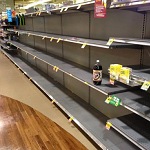 hurricane approaching Florida or the Gulf States, even one of moderate size, the stores quickly sell out of bottled water, batteries, power generators, and similar necessities.
When the tsunami and power plant disaster happened in Japan in March of 2011, panic buying by consumers quickly stripped the store shelves bare in Tokyo, a city 150 miles away from the power plant disaster site. The disaster did not directly affect Tokyo. Food stores were sold out due mainly to fear. But regardless, there was no food available for purchase.
We’ve also seen shortages of ammo in recent years due to fears that the federal government might place new and severe restrictions on firearms and ammunition. The effect was less of a sudden spike, and more of a gradually increasing wave of extra purchases. As a result, the effect lasted much longer. Even now, prices are up on ammo and availability has not fully recovered.
But the principle can be applied on a larger scale. The cause could be: severe economic disaster, a catastrophic failure of the U.S. electrical grid, an economic disaster (e.g. the gov’t defaulting on the national debt), a dirty bomb attack on U.S. soil, a national outbreak of Ebola, or a dozen other severe disasters. On a larger scale, panic buying could threaten our ability to obtain enough food. Gov’t intervention could make matters worse. Protests would likely turn violent. Many people would resort to violent crime to obtain the food and other supplies they need.
But you’ll still be able to buy the latest smart phone or video game. So it ain’t all bad news. Necessities will sell-out quickly. Unnecessary items will still be available. Instead of waiting in line for hours to get the latest electronic gadget, people will queue up for food. Just like i the old Soviet bloc nations.
Prepping for this eventuality means storing food, starting a garden, storing seeds and gardening supplies, storing batteries, maybe buying a small solar panel, etc. As a prepper, I’ve been lax lately. The absence of recent disasters has left me a little complacent. I have to remind myself and my readers that disasters happen suddenly and unexpectedly. And sooner or later, some type of SHTF situation will occur.
- Thoreau
Good article, but at this late date if someone has a limited’ spend a few dollars a month’ on prepping budget, then it is probably already too late. Anything is better than nothing, but for the johnny/jane come lately to the prepping world it could be one year too late. We shall see, and thanks again for the article.