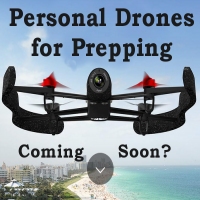
 Not so many years ago, this topic would have been solidly in the SciFi category. Today, it can be done, with off-the-shelf hardware. But it’s expensive. Within a few years, personal drones might be relatively affordable. The only question will be whether the feature set matches our needs for prepping and survival purposes.
Usefulness
What would be the usefulness of a personal drone for prepping? The main use would be for surveillance and security. A drone with a remote camera could be used to survey the surrounding area, much further than you could see from your property. In a SHTF scenario, you will want to know if there is any type of crime or disturbance nearby: roving gangs of armed men, a wildfire approaching, damage from a storm or other natural disaster has passed, etc. Today, we rely on news media and phone calls to obtain this type of information. If there is a breakdown in modern communications, we might benefit from a new way to be informed about the local situation.
If you have a large property, perhaps including crops some distance from your house, a personal drone could be used to survey the crops. This process would be much quicker and would provide much more information than lacking or driving the land. A bird’s eye view of a field, with the ability to drop down and examine any particular spot, would tell you much more about the state of the crop.
And if you have livestock, the drone can be used to catch up with them quickly, and see how they are faring. It’s not unthinkable that a drone could be used to herd the livestock (perhaps with some type of noisemaker on the drone, if the sound of the drone is not enough). It might also be useful for chasing off a predator, or at least locating a predator, so you can dispatch the animal with a rifle.
Could a personal drone be used for hunting? Right now, you’re probably imagining a small drone, equipped with a guided missile or perhaps a remote-controlled rifle. Hilarious. No, I meant that the drone would be used to locate prey, such as deer or hogs. It would speed up the hunt to be able to find game animals quickly. And if the drone is flying high enough, the noise won’t startle your prey. But then you would still have to kill the game the old-fashioned way: lead and gunpowder, glass and steel.
Other uses? Delivery of goods ordered over the internet? I doubt it. Personal transportation by drone-like hovercraft vehicle? Not on my budget. I think surveillance is the main usefulness of a personal drone for prepping.
Cost and Availability
Right now, personal drones with remote cameras are expensive, and the flight times are too short. But we are on the cusp of a revolution in drones. The prices are falling and the capabilities are increasing. What’s available now? Glad you asked. But be advised that I’m not recommending the purchase of any of these items. My opinion is that personal drones are not ready for prime time. (All prices are as of this writing and subject to change.)
The UDI U818A Quadcopter is under $100 at Amazon. It is equipped with a remote camera. However, flight time is way too short at 7 to 9 minutes. And I’m going to go out on a limb and surmise that the quality is low for a sub-$100 drone made in China. The price range is right, though, and eventually the quality will come up.
Parrot is one of the top manufacturers in the personal drone category. Their current top offering is around $300 for an easy-to-pilot drone with HD 720p Camera streaming video. Range is maybe 30 meters. Flight time is about 10 minutes, but you can double that if you swap in a higher capacity battery. Not bad for the price.
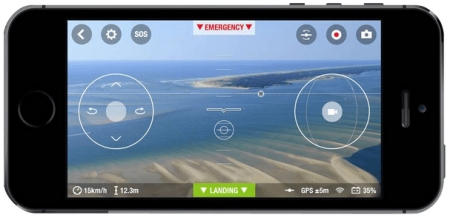
What’s next? Parrot is promising a new drone: the Bebop. Specs are astounding. With the extended range package and Skycontroller, range is about 2 kilometers. If it flies beyond control range, it has an autonomous flight and return to take-off position function that kicks in. Flight time is expected to be short and cost will be on the high end — easily over $1000 when all is said and done.
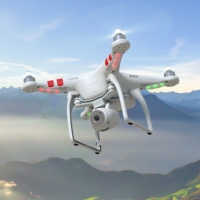 Another company, DJI, makes the Phantom series of drones. These are currently priced in the $500 to just over $1000 range. They have a full set of features that you would want in a drone, including high-res camera and decent range (300 meters). Available now, flight time is about 25 minutes.
There are higher end drones, used by commercial companies for surveying and mapping. These are in the several thousand to several tens of thousands of dollars price range. These products are not just too expensive, they are also (in my estimation) too complicated for the non-professional consumer to use.
Limitations
Range versus price is a limitation. The relatively affordable drones have a WiFi range of dozens of yards. This limits the usefulness of the drone severely, making it not worth the moderate price. The high end pro-sumer drones have decent range: 1 to 2 km is good enough for prepping purposes. But the price is too high for most preppers. Maybe you have a farm with crops and/or livestock, and you can justify the cost based on the income from the farm. Otherwise, it’s an option for hardcore survivalists and very dedicated preppers, not the average joe.
Flight time is also a big problem: 10 to 25 minutes is a severe limitation. If you are looking over your crops or looking for game or predators, you need more than a few minutes of flight time. Subtract the time to get to a location, and to return, and you are left with precious few minutes for any serious task.
Why don’t these drones have solar panels? Because they hover. And hovering with 4 rotors uses more power than a solar panel could provide. The weight of the panel would necessitate more rotors to lift the craft, which would then require more panels, and so on. The professional drones are more like planes; they don’t hover. One prop pushes the vehicle, and its wings do the lifting. That type of flight uses much less power, and might benefit from a solar panel. If the panel can’t supply all the power, at least it could extend the flight time.
Once personal drones start to become more common in the 1 to 2 km range, they will have to switch from a multi-rotor copter to a single-rotor plane. With the latest solar panels, lightweight and high efficiency, we might start to see personal drones with much longer flight times and more affordable prices.
Wind conditions are also a limitation. Anything over 15 mph presents flight and stability issues for a hovering copter with limited battery power. It can’t fly against the wind. It gets pushed off its flight path. A switch from copter to plane may ameliorate the problem. But weather will still be a limitation for any small and affordable drone.
When can we expect a feature set and price that makes personal drones a good fit for prepping? I would suggest that it could be only a few years away. Current offerings are pretty close to what I would want.
- Thoreau