Many people think of their stored food in terms of meals: how many days’ worth of complete meals have I stored? That metric is useful. But another way to consider stored food is in terms of macronutrients: protein, fat, and carbohydrates. As long as you have sufficient protein, fat, and carbs stored, you have a sound foundation for a healthy diet. You can then add other stored foods, food that you continue to buy, and some fruits and vegetables from a garden to that foundation.
Dietary fat is difficult to grow in a garden, but inexpensive and easy to 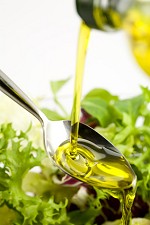 buy and store. Most vegetable oil will keep 1.5 to 2 years; see the “best by” date on the package. But how much vegetable oil should you have on hand per person?
The US RDA values are based on a diet of 2000 calories (technically, kilocalories) per day. And that figure is based on a value of 1800 kcal/day for an average adult woman, 2200 kcal/day for an average adult man. Those “averages” are for adults in a relatively sedentary society, such as the U.S. today.
However, I would suggest that many scenarios, for which we prudently prepare, might cause us to be more physically active. This would imply that 2000 kcal/day is too low. Also, it is better to overestimate our food needs, and end up with too much food, rather than underestimate and go hungry. So let’s set the kcal/day at 2740, which is an even one million kcal/year. I think that value is a safe over-estimate, and an easy figure to work with in terms of kcal/year.
What percent of those kcal should be dietary fat? If you are sedentary and 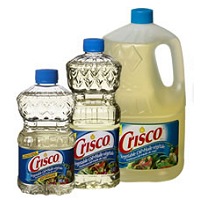 maybe a little overweight, you might want to limit fat calories to 15 to 20% of total kcal/day. But the typical American diet is about 30% kcal from fat. That value is not so bad if you are physically active. Fat is an essential nutrient, and has high caloric density. It also makes you feel full, rather than hungry, which is important when there is a disruption to the food supply. At 1 million kcal/year and 30% of those kcal from fat, you need almost 34 kg of dietary fat per year, which is about 3 liters of vegetable oil per month.
Well, that’s if all your fat came from vegetable oil. Since many foods contain some fat, you really need less oil. So let’s assume you get 2/3rds of your dietary fat from vegetable oil: 2 liters per month. That might not be the case with your normal diet, but if there is a disruption in the food supply, you will likely be getting less fat from meat, poultry, and dairy, and more from vegetable sources. How much oil is that? About 4 tablespoons per day (2 oz/day) and about 64 oz per 31-day month per person.
- Thoreau