
I’m sure just about everyone has heard about the bad storms  over the last week and a half or so that were blamed for the deaths of more than two dozen people and which left almost two million others without power for nearly a week in the Mid-Atlantic region. While this is obviously a terrible tragedy I’m hoping we can at least learn something from what happened so that we can be better prepared should a similar event affect our lives.
First of all, as Thoreau pointed out in an earlier post on these storms, you have to be prepared ahead of time. There’s very little use rushing out to the store after the storms have hit. The shelves are most likely empty and the items you really need are unlikely to be available. Also, while government assistance arrives on scene fairly quickly in an event that only affects a relatively small part of the country, do you really want to have to rely on government handouts or have to live in a shelter? No way. So be sure to have everything you need to be self sufficient ahead of time.
Secondly, in a disaster that only affects a small part of the country, Bugging-Out (or “Partially Bugging-Out”) is a decent option. The Mid-Atlantic storms are an excellent example to use here as they affected millions of people but in a relatively small part of the country. This would be similar to an earthquake that does a lot of damage in one big city and the surrounding areas, a bad ice storm that hits particularly hard in one area, or any other event that leaves areas only 200-300 miles away unscathed. In this type of scenario hopping in your car and driving to a town that has not been affected is a real option. Or, you could choose what I like to call “the partial bug-out”. Meaning Dad or Mom could choose to stay at the house and keep an eye on things and assist with clean up while the other takes the kids someplace safer and more comfortable, like a Hilton  in a city that has power. I like this option when there are young children in the family as I think it gets them out of harms way and makes things easier on the parents. For families with older kids there may be important lessons for the kids to learn in staying and working through a minor disaster, provided you feel safety is not an issue.
In thinking through the “partial bug-out” you need to take a couple of things into consideration. One, is it safe enough and are roads clear enough for those who choose to bug out to make it to their destination? Two, do you feel comfortable splitting up or would you rather all stay together? And other questions you should ask yourself depending on the specific situation.
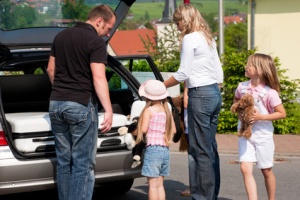
Generally, you’re trying to figure out if it’s safe enough and worth the expense to get most of your family to a comfortable location where they don’t have to endure the hardship faced by many after a disaster like this. For those of us that are very well prepared and have plenty of food, water, and other necessities it’s probably a toss up. For those who have not taken the time to prepare I think it’s a no-brainer. Even if it means a credit card bill that could take some time to pay off your best bet is to get your family someplace safe and comfortable. In the end, the cost of the bug-out would probably be about the same as the cost of the food, water, and other supplies you should have had stored in the first place…
~Butch

The hotel/motel bugout is one of our plans in the event of a forest fire that forced us to evacuate. Figured I’d use a credit card when possible and save cash, just in case. Haven’t really given it much thought beyond that, but locating a couple motels that suit your needs now might be a good idea. Extended stay, pet friendly, kitchenette, pool for the kids, or whatever. Map out a couple different routes, and keep their phone number handy. I’d tend to think a family owned one in a small town might be better than a national chain one near a major airport/city/tourist destination. Keep the list/details in the BOBs.
If you have pets that will be coming, might want to make special arrangements for them too. I keep a copy of our dogs licenses and vaccination records in our BOBs, and always keep their kennel cough vaccination up to date along with the rabies/distemper. All the kennels I’ve ever seen require that. There’s also some service dog certification services online, just give them some money and they’ll send you personalized documentation (and an embroidered collar/lead) that your mutt is a “service animal”, not a pet. One I saw also includes a pocket copy of the “Americans with disabilities act” that service dogs must be allowed in hotels (and most other places), regardless of establishment’s pet policy. Maybe something to consider.
Wanted to comment on a couple of things since I just lived through the mid-atlantic mess:
1. To WALT specifically (and others that plan to use credit/debit cards: This storm FRIED most of the card readers in my area and most places did NOT have a paper option. Cash is always BEST, in my opinion, for this very reason.
2. I tried a partial bug-out first then reverted to bugging IN. Main reason: hotels in my area would NOT accept my pet cat. Be sure you double check the finite details before choosing. My cat is fixed, declawed, and litter trained, but they still said no cats. Dogs were ok up to 25 lbs (over 25 lbs not so much), and BREED was also considered in some places-for instance, NO pit bulls or dobermans allowed. So, just realize that a partial bug out can be far more complex in reality than it seems in your head.
If all we are deprived if is no A/C or Disney channel for a week, I am not going to incur a hotel bill. These storms were not a SHTF event, just a bump in the road.